 Spin Atlas
Plays vs minutes: choose your personal music awards
Your most-played artist and your artist of the year can be different. Spin Atlas turns imported listening history into a music record book with six editable annual awards. It starts with calculated winners, then lets you choose your own without changing the recorded plays, minutes or rankings.
When your most-played artist is not your artist of the year
Consider this separate, fictional 2024 history. It contains exactly 30 recorded plays and 100 minutes. The durations are invented listening amounts, not the lengths of particular songs.
| Artist | Recorded plays | Time per play | Measured listening | Rank by plays |
|---|---|---|---|---|
| Taylor Swift | 20 | 2 minutes | 20 × 2 = 40 minutes | 1 |
| Kendrick Lamar | 10 | 6 minutes | 10 × 6 = 60 minutes | 2 |
Taylor leads by plays; Kendrick leads by minutes. Plays count recorded listening events. Minutes add their measured duration. Neither establishes enjoyment, attention or personal significance.
New Spin Atlas books use recorded plays for automatic awards, so Taylor starts as Artist MVP. Sorting a table by minutes changes the display order, not the automatic award or the rank calculated from plays. If a source supplies no measured duration, as with some Last.fm or ListenBrainz files, minutes remain unknown.
Does a short play count?
Separately from the 30-play example, a valid Spotify music record with ten seconds of listening contributes one recorded play and ten seconds in Spin Atlas. It does not mean a whole song was heard. Zero-duration entries are excluded.
Spotify for Artists defines a song stream using a minimum of 30 seconds. That is a different measure from Spin Atlas’s recorded plays. Neither that rule nor this example establishes Spotify Wrapped’s ranking methodology; do not expect these totals to reproduce Wrapped.
Choose Kendrick while keeping Taylor’s lead
If Kendrick feels like your artist of the year, you can make that choice explicitly. The app does not infer it from the longer listening time.
- Open the year’s awards from Seasons or Honours.
- Open Artist MVP and compare the candidates’ listening statistics.
- Choose Kendrick Lamar. The award identifies this selection as Your pick.
- Use the reset option to return to the calculated winner whenever you want.
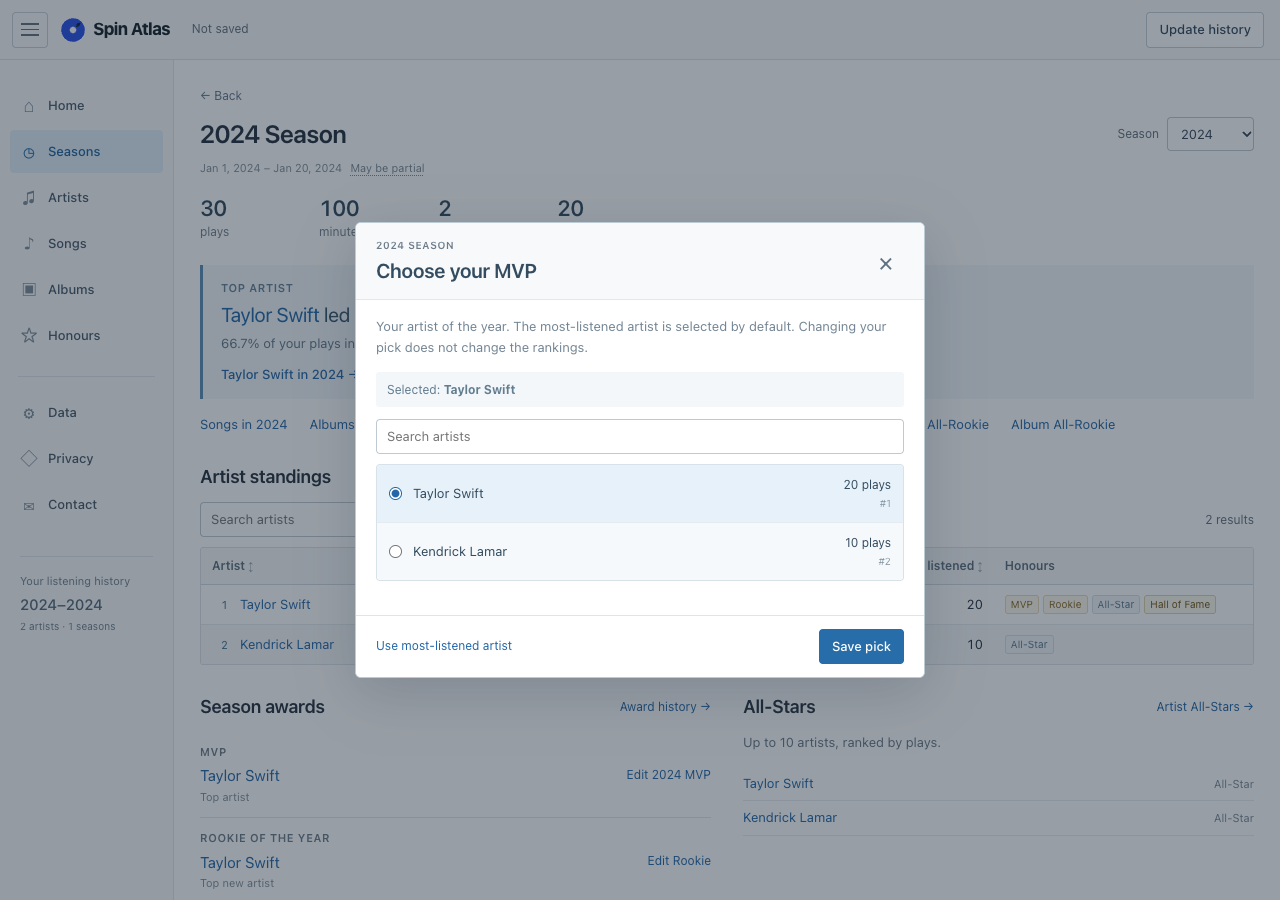
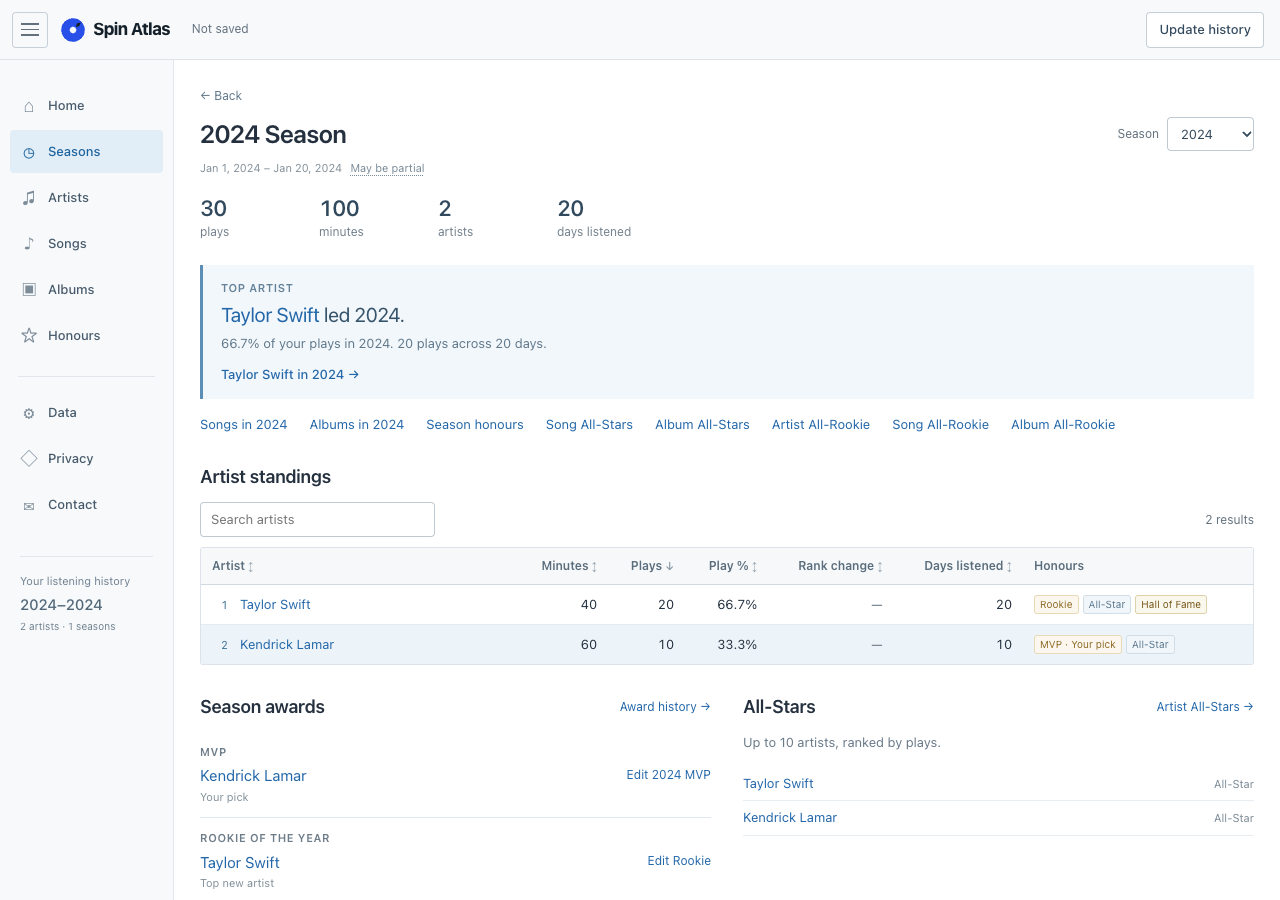
After the change: Kendrick is your personal MVP. Taylor remains rank 1 with 20 plays and 40 minutes; Kendrick remains rank 2 with 10 plays and 60 minutes. The season still totals 30 plays and 100 minutes. Your award and related career honours change; the listening record stays intact.
Six annual awards, with eligibility kept visible
The same distinction between measured results and personal choices applies across the awards:
- Artist MVP: starts with the year’s artist leader.
- Artist Rookie: starts with the leading eligible artist.
- Song of the Year and Album of the Year: start with the leading eligible song and album.
- New Song of the Year and New Album of the Year: start with the leaders in their recorded-listening classes.
Calculated rookie and “new” eligibility requires at least three plays in the year and fewer than three across earlier recorded years. This describes your archive, not release dates or proven discovery. Missing earlier history can make an old favourite look new.
A personal Artist Rookie can be any artist heard that year, but an artist can win it only once; moving the award requires confirmation. Song and album pickers show their eligible choices. Personal annual awards do not rewrite the separate All-Star or All-Rookie team rosters.
Start with your history and keep your choices
Import your history and review its date coverage. Spotify listeners need Extended Streaming History; Spotify’s data reference describes its contents. Use the year-by-year guide to check a season before awarding it.
Importing processes files in your browser without uploading them. Enable browser saving to retain your book and choices there; an unsaved import disappears on reload. Optional Save online uploads the calculated book and choices to private account storage. See Privacy for storage and usage-measurement details.